Feeds:
Posts
Comments

I’ve continued to spend time with God on this idea of returning to my first love.  I so want to encounter and experience God in a deeper, more permanent basis.  I spent time on:

Matthew 3:8 – Bear fruit in keeping with repentance  and  Rev 2:5b – Repent and do the works you did at first.

If you’ve been reading these blogs over the weeks, I’d shared with you that I’d left my first love (Jesus) in that I was coming more and more to rely on self (and, subtly, pride was the root there).

I believe I’ve repented, but how do I know for sure?  Matthew 3:8 and Rev 2:5b give us a clue.  I got to thinking: what is repentance?  And as I spent time with God on this, here is what I am pondering:

Repentance comes from a godly sorrow (see 2 Cor 7:10) and will result in a lifestyle, plan, choices, activities geared toward making good fruit possible.

As I thought about “doing the works I did at first,”  the Holy Spirit clearly reminded me that I used to:

– Pray consistently

– Read and treasured the Bible and other works that helped me understand it

– Act according to conviction with friends and strangers (that is, I didn’t “follow the crowd”)

– I shared Christ when I saw/sensed opportunity

These were things I did as a child and adolescent!  As I’ve grown, I’ve drifted from my first love via benign neglect.  I don’t do the above things like I used to — and I don’t do them because I’ve “forsaken my first love” in relying more and more on self (again, pride is really at the root there).

This has been a painful thing to deal with, but a necessary thing in breaking up the “fallow ground” of my heart and seeking the Lord (Hosea 10:12b).

But oh the joy of sensing the Holy Spirit present and active in my life!  Oh, the joy of recognizing that still small voice once again!

If any of this resonates with you; if you also sense God calling you to return to your first love, I encourage you to break up our fallow ground (repent), and seek the Lord until He is found — then there is true fulfillment in Him and opportunity to make an impact in His kingdom!

As a Bible teacher one of my goals is to get folks to think through their faith; to delve into the practical ramifications of Scripture and spiritual teachings; to wrestle with, and exercise in real life, their faith.

One Sunday, I asked questions around a fulfilled life and whether we can do all that Jesus did.   The hope was that all of us in the class would begin to think and pray through:
a)  what Jesus meant when He said, “…anyone who has faith in me will do what I have been doing.  He will do even greater things than these, because I am going to the Father.” (John 14:12)
b) the relation of a fulfilled (or fulfilling) life with Jesus’ prayer for believers in John 17, especially vv 3, 15-24.

In thinking through these Scriptures and others around the fact that we are beloved, chosen and blessed, I am coming to believe a fulfilled/fulfilling life is one in which we are indeed in God and Jesus (John 17:21) — one in which we are partakers of the divine life/nature (2 Peter 2:4).  Such a life is not one in which we separate ourselves from the world.  We don’t have to give up our jobs or families or withdraw from social or political or other activities.  It is not one in which we must spend all our time at the church building or only with Christians or in long hours of prayer.

Quite the opposite!  As Jesus prays, as believers we are sent into the world to continue the work Jesus began.  In fact, we can do even greater things in that work/purpose than Jesus Himself did! (John 14:12)

A fulfilled/fulfilling life, then is one in which Jesus is lived out in us.  As beloved sons and daughters of God the Father, our lives become a continuation of Jesus’ mission.

And we continue that mission in the context of where we are — in our families, work, and other activities.  There are as many ways and contexts to fulfill the mission as there are people.  

It is in intimate relationship with God, via the Holy Spirit, made possible by Jesus’ death and resurrection, that we are enabled to fulfill the mission.

Praise to God that He has purposed for us to participate in the divine nature, to see His glory, to become like Jesus, and to bring Him to the world, that others might know Him.   One of the reasons we are chosen, blessed and beloved is to be given to the world, just as Jesus was, that the world might know Him.  As we live in obedience to this mission more and more — then we are living fulfilled (and fulfilling) lives.

What a wonderful calling — a wonderful present — and a wonderful future!
If you’re a regular reader of this blog, you know I’ve been wrestling with the ideas of holiness and obedience.  Again and again, in my recent devotionals; in many sermons, books, articles — I’m exhorted and encouraged to obey God.
Again and again, in the Old Testament, God the Father calls for His people to obey His commands.  The result, we are told, is blessing (see, for example, Deuteronomy 6:3 and 11:26-28).
But more and more, as I continue to study His word, pray and meditate on this, I believe I have things backwards and the wrong idea of obedience.  It’s not a “this for that” bargain with God — such as: if I obey, He’s under an obligation to grant me my various wishes.
In the past, I have repeatedly striven to obey — and again and again, I have found myself back in a habit of disobedience — not “great sins” per se — but in a general failure to put God first and my neighbor ahead of myself (see Philippians 2:3-5).
Why is this, I ask myself — usually under a cloud of depression and guilt.  Why can’t I obey God?  Why don’t I consistently want to obey God?  Doesn’t Jesus say, “if you love me, you will obey what I command?”  (John 14:15)
And there it is — right there in that verse.  It’s not in my own strength that I will find willing and consistent obedience.  No, the key is my desire for relationship — I’m back to that subject from many weeks ago — leaving my first love and benign neglect.
It’s as I consciously love God, consciously choose Him, strive after Him that obedience results.  It is the relationship, the faith from which obedience will result!
This is what Samuel was talking about when he told Saul, “Does the Lord delight in burnt offerings and sacrifices as much as in obeying the voice of the Lord?  To obey is better than sacrifice, and to heed is better than the fat of rams.”  (1 Samuel 15:22).
The rote obedience of religion (burnt offerings and sacrifices) is not what God is looking for.  It is the love, the relationship — the delight in seeking Him, hearing His voice, and as a result, obeying.
God wants our hearts!  He desires relationship with us.  When Jesus talked of the greatest commandments being “Love the Lord your God with all your heart and with all your soul and with all your mind” (Matthew 22:35), this is what he was talking about.
Thus it can be said, “And this is love: that we walk in obedience to His commands.”  (2 John 1:6a)
It is an obedience that comes from faith — from a love for and intimate relationship with God.
I hope this makes sense.  It is this realization that frees one from the “grim drudgery” of obedience, to the new life that Paul speaks of in Romans 6:4; 7:6 and 2 Corinthians 5:17.
I close with the prayer I prayed at the end of my quiet time as I thought through this writing:
Lord,  It is so easy to forget You and place myself first.  Forgive me for the tendency to return to self — for that being my first love.  My I become a child who longs to have relationship with You, and as a result, strives to please You as the norm of my life.
“… for the Lord searches every heart and understands every motive behind the thoughts.  Consider now, for the Lord has chosen you …. Be strong and do the work.”  (1 Chronicles 28:9b, 10)

Holy, Holy, Holy

holier-than-thouWhat comes to mind when you hear the word ‘holy?’  Or when you hear the exhortation that Christians should ‘be holy?’

If you’re like me, it conjures up images of rules, regulations, somberness, a removal of myself from the world’s activities.  Judgement/judgmental. Puritanical. Pharisaical.

But is this what being holy is all about?  Certainly, we are to be holy (see Hebrews 12:14). But is it really all about rules, regulations, and judgement?  Man, what a turnoff!?

But maybe, just maybe, that’s the totally wrong way of looking at holiness.  Take a look at these verses (in which Jesus is speaking):

Luke 2:49b (KJV) – ‘Did you not know that I must be about my Father’s business?’ John 10:37 (KJV) – ‘If I do not the works of my Father, believe me not.’       Matthew 26:39 (NIV) – ‘My Father, …, may this cup be taken from me. Yet not as I will, but as You will.’

From beginning to end, Jesus was focused on the one thing — doing the will of his Father.  The center of his life was this obedient relationship.

This, indeed is what holiness is about.  Matthew 6:33a puts it — “Seek first His Kingdom and His righteousness…”

This may be hard for us to understand because in today’s culture obedience has negative connotations.  It implies an oppressive authority figure imposing their will against our desires — taking our freedom — hard tasks done under threat of punishment.

But that is NOT what Jesus’ holiness was about.  It was a total commitment to his LOVING Father.

When we begin to understand this about holiness, then we will begin to see how to be ‘in the world, but not of the world.’  We will also begin to see and live in such a way that the many things in our life should (and can) be rooted in the one thing — listening to the loving Father, seeking His kingdom, participating in the divine nature (2 Peter 2:3).

It is then that Jesus’ prayer in John 17:15-18, 21b becomes reality:  “My prayer is not that you take them out of the world but that you protect them from the evil one.  They are not of the world, even as I am not of it.  Sanctify them by the truth; your word is truth.  As you sent me into the world, I have sent them into the world. … so that the world may believe ….

As believers in Christ, as God’s beloved children, may we indeed be holy!

Family History Jeff & Mary Wedding Day 1989My memory is not very good.  My wife will often ask me if I remember some event from our past, and very often I simply can’t recall it.


One thing I remember vividly, however, is the first time I saw my bride in her wedding dress.  She was perfect!  She was so beautiful, it took my breath away (she still is, and does).

Now my bride Mary had taken great pains to get ready for our wedding day.  She didn’t just pop out of bed that day and, “poof” was all ready.  Imagine if she had simply shown up in her flannel pajamas, with bedhead, makeup leftover from the night before, ……  What would the people present have thought?  What would I (the groom) have thought?  Namely, that she wasn’t particularly concerned about us or me or what our wedding would mean.

Pretty nonsensical, huh?  What bride would fail to be ready for her wedding?  What bride would be ignorant of the fact that preparation would be necessary?

Scripture tells us we, as the church, are the bride of Christ.  And yet, I wonder if we as individual Christians and as the church are going to “show up in our flannel pajamas” at the marriage of the Lamb (Rev 19:7)?

Ray Vander Laan, in his excellent book Echoes of His Presence, relates that in the Jewish custom of Jesus’ day, the groom (or groom’s father) would pay a bride price for the woman the groom desired.  The groom would then offer the betrothed a cup of wine.   The bride would choose to take the cup and drink, or she could refuse.  If she accepted, she was accepting his offer and committing her life to him.  She was betrothed — engaged!  She would then spend the time between the betrothal and the marriage ceremony preparing to be the bride and wife that would honor her husband. While she was doing that, the groom had left to prepare a place for his bride. When all the preparations had been made, he would return for his bride.

I hope you’re seeing the connection — Jesus has paid a bride price for us — His very life.  We accepted the cup when we repented and placed our faith in His death and resurrection.  Our responsibility is now the same as that of the Jewish bride.  We should be preparing ourselves for His return!

How do we prepare ourselves?  Take a look at Hebrews 12:14; Romans 12:1-2; 2 Corinthians 7:1; 1 Peter 1:13-16.

What is the common theme?  Be holy.

More on this in subsequent blogs.  For now, I ask you — have you forgotten about the wedding?

This is Living!

tumblr_inline_naeg69M9jw1sly8qu

I recall a vacation Mary and I took many years ago.  We “splurged” and stayed at a fine hotel/spa. It had the best of everything — the best food, the best golf, the best massages, the best pool, the best hot tub.  I recall at one point saying to her as we entered the spa — “This is living!”

And while the vacation was wonderful, if that was living, then we’d really missed out on life.  If we really want to live, we can’t look to the world (and thus it’s values) as the source and purpose of life.

Henri Nouwen in his book, Life of the Beloved points out that one of the great struggles facing believers in Jesus is not to isolate ourselves from the world — not to reject our ambitions and aspirations, or to despise money, prestige, or success — but to live in the world as someone who doesn’t belong to it.

And how do we do that?  May I suggest John 20:20-21 provides insight to the answer?

We have been sent!  Sent by God into the world!  Why?  Read John 3:17.  As God sent Jesus, so He sends us!  Not that the world will be saved through us — but that we will reveal Jesus, through whom salvation comes, to those around us.  Read 2 Corinthians 5: 17-20.  This is why we are sent!

Everything will begin to change radically for you when you know yourself as being sent into this world.  YOU have a purpose!

“When we realize that our few years on this earth are part of a much larger eternity that stretches out far beyond our birth and death, life will cease to be a “losing battle”, a hopeless struggle, a journey of despair.”  (Nouwen, Life of the Beloved)

When we live our lives as beloved ones of God sent into this world, then we live life with a mission, a purpose.   And we live a life that cannot be conquered by this world or by death.

To paraphrase from Nouwen:  The world may consider our lives little and insignificant.  BUT when we realize that God has chosen us from all eternity and sent us into the world with His blessings and that we are His beloved ones, we can then begin to imagine and trust that our “little lives” will multiply and fulfill the needs of many people — will have real impact for and in God’s Kingdom.

Imagine, imagine, imagine — imagine that in dying to self, in giving of yourself, you will have impact that far exceeds your life — there will be ever-widening ripples like that of a stone thrown in a still pond.

“Do nothing out of selfish ambition or vain conceit, but in humility consider others better than yourselves. Each of you should look not only to your own interests, but also to the interests of others. Your attitude should be the same as that of Christ Jesus: Who, being in very nature God, did not consider equality with God something to be grasped, but made himself nothing, taking the very nature of a servant …” Philippians 2:3-7

Are You Plugged In?

WNJli6BMPqxLSSRH.standard

Have (or do) any of the following ever applied (apply) to you:

  • I am strongly tempted to sin
  • I give in to temptation and choose to sin
  • I feel overpowered by the pull of a particular sin in my life
  • I know what God wants me to do, but just don’t have the desire to do it.

I came across this question in my continued study in Nancy Leigh Demoss’ and Tim Grissom’s Seeking Him — Experiencing the Joy of Personal Revival. — And I was initially depressed by the fact that all of these statements have applied to me at one time or another (and still do sometimes).

But, thankfully, God has something to say on this.  I went on to read through Hebrews 4:14-16; Titus 2:11-12; 1 Corinthians 15:10; and 2 Corinthians 9:8.

As believers in Christ, as beloved ones of God, we have one who has been tempted as we have — who pleads our case before God.  AND we have God’s grace!  I urge you to read those above versus carefully — it is God’s grace which provides the power and the training.  God’s grace can be a dynamic force in our lives and result in our sanctification (becoming more and more like Christ — living triumphantly in accordance with our new nature).

Imagine — in all things at all times abounding in every good work — as a result of God’s grace (2 Cor 9:8).

Some of you may be struggling with temptation and sin or wondering, “if it’s all God — all His grace, then why don’t I have the desire to obey God — to walk with Him in relationship?”  You may be struggling with discouragement, despair, and wanting to give up.

In my own struggles, I’ve come to learn that we play a role!  It is God’s grace, but we must be plugged into that dynamic force.  Otherwise it’s like wielding a jackhammer with no power.  You get nowhere and eventually give up.

Read 2 Tim 2:1; James 4:6; 2 Peter 3:18.  All of these verses talk about standing in God’s grace, being strong in God’s grace and growing in God’s grace.  If we’re not plugged in — not active in our relationship with Him, not taking the steps necessary to be plugged in and maintain a relationship with God and His church, we will be disconnected from that source of power.

Remember, the Lord has promised He will be found by those who seek Him; He will never forsake those who seek Him; and He will be faithful to complete the work He has started in you!

So be plugged in, ready for use, wired — stand and growing in the grace of God — and God’s grace will not be without effect (1 Cor 15:10); He will work in you to both desire and do His good pleasure (Philippians 2:13).

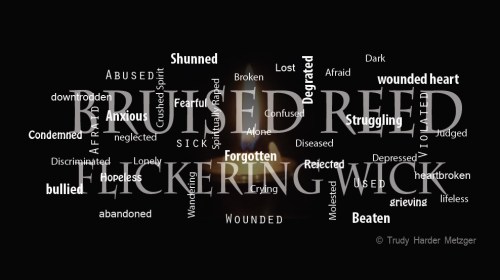
Bruised Reeds

bruised-reed

Isaiah 42:1-4 speaks of the type of servant God will uphold.  In particular, these verses refer to the Messiah (see Matthew 12:15-21).  I’m drawn particularly to verse 3 — “A bruised reed he will not break, and a smoldering wick he will not snuff out.”

In his book The God of the Towel, Jim McGuiggan notes the reed referred to in this passage (a kaneh in Hebrew) was one that grew tall and was used in a variety of ways.  However, it was very fragile and if they were damaged (bruised), they were considered useless.  A smoldering wick was one in which the oil in it was nearly exhausted, and thus it began to dry out and give off smoke as the flame began to die.  The natural thing to do would be to snuff it out.

And isn’t that how we often think God will treat us — we who are struggling with addiction or going through separation or coming to terms with having betrayed someone’s trust?  Or who are dealing with sickness or the loss of a loved one  or the wayward child or job loss.  We are broken and spiritually dried out.  Who could blame God for getting rid of a bother, a useless aggravation, an exasperating failure?

But God doesn’t do that!  He doesn’t despise a “bruised reed.”  He knows how fragile you are and He will not give you so much that you will splinter and break. As McGuiggan notes, He will carefully, without overwhelming the feeble wick, gently blow and expertly remove debris, prod and fan and pour in new oil so the sputtering, almost extinguished flame can burn bright and give light.

For some of us, in order to begin this renewal, He is just waiting for us to return to our first love.   Not only waiting, but reaching out to us.  When we finally give up trying to make it on our own, refusing to come to God with that unconfessed, unacknowledged sin; when we give up our pride, and come to Him with godly sorrow and repentance,  we will experience the joy and blessedness that David spoke of in Psalm 32.

For others of us, we are “broken” not because of sin we haven’t dealt with, but simply because of what life has thrown at us.  Broken relationships between parents and children, husbands and wives, friends and colleagues; Dreams unfulfilled; Rejected for job; Living on the financial edge; Abused; Sick.  All of these things result in loneliness, frustration, fear, insecurity, feelings of worthlessness.

But read Isaiah 42:1-4 again.  How heartening!  What joy!  God will not toss out the weak, or trample “the bruised” and “the smoldering”, those who might otherwise feel useless or too broken to matter.  Remember — as a child of God, YOU are Beloved and chosen by Him.  He will never leave you nor forsake you.  Walk with Him, rest in His love, and know that you have a place and a usefulness in His plan.

“Come to me, all you who are weary and burdened, and I will give you rest.  Take my yoke upon you and learn from me, for I am gentle and humble in heart, and you will find rest for your souls.”  — Matthew 11:28-29

Beloved

Have you ever known someone who was truly humble?  Not someone who constantly put themselves down or had very low self-esteem.  That is not healthy nor biblical humility.  Have you known someone with biblical humility?  How did it evidence itself in their lives?

As I continue to dwell on, study and pray about this idea of “returning to my first love,”  two thoughts are revealed to me.

a) Biblical humility is a must for such a return and maintenance of an intimate relationship with God.  Biblical humility – recognizing oneself as a sinner before, and in need of, a holy God.

Isaiah 57:15 – ….. I [God] dwell …. with him who is of a contrite and lowly spirit, to revive the spirit of the lowly, and to revive the heart of the contrite.

b) We are beloved by God.

Rom 9:25 – As indeed He says in Hosea, “Those who were not my people I will call ‘my people,’ and her who was not beloved I will call ‘beloved.’

It’s important to have biblical humility in conjunction with the personal understanding that we are beloved by God.  Otherwise we end up only in a guilt complex and/or self-loathing.

Being beloved by God is the true core of our existence.  It is in understanding this, in taking it into the core of our being, that we develop biblical humility.  It is then that we have “godly sorrow leading to repentance” (2 Cor 7:10).  It is then that we will have a true (and healthy) biblical humility that flavors how we see ourselves, others and how we live and move in this world.  It makes Philippians 2:3-8 become possible in our lives.

“But as long as ‘being the beloved’ is little more than a beautiful thought or a lofty idea that hangs above our lives to keep us from becoming depressed, nothing really changes.  We ARE beloved.  We are intimately loved long before our parents, teachers, spouses, children or friends loved or wounded us.”  — Henri J.M. Nouwen in Life of the Beloved.

That’s the truth spoken by the Holy Spirit who lives in all of us who are believers in Christ Jesus.

As you pray, listen!  God calls out to you, His beloved.  “I have called you by name from the very beginning.  You are mine and I am yours.  You are my beloved, on you my favor rests.  I have molded you in the depths of the earth and knitted you together in your mother’s womb.  I have carved you in the palms of my hands and hidden you in the shadow of my embrace.  Wherever you go, I go with you.  You are my beloved.  Nothing will ever separate us.”

This is love: not that we loved God, but that He loved us and sent His Son as an atoning sacrifice for our sins. — 1 John 4:10

Returning to your first love begins with godly sorrow, biblical humility, and a recognition that we ARE beloved by God — and always will be.

Our New Community Group (fancy title for Sunday School class) recently dwelt on the impact our faith is having in our lives and the lives around us.  I subsequently spent some time mediating on Revelation 2:1-5 and Jeremiah 17:7-10.

I’m challenged by these passages — Revelation 2:1-5 and the charge to/against the church at Ephesus seems to capture what I think of when speaking of “benign neglect.”  Here was a church body, a people who had done “good works,” endured for Christ’s sake, attempted to remain pure — and yet … they had been weighed and found wanting — how?

They had “left their first love.” (NKJV)  The NIV renders it “forsaken your first love.”

With such commendations as Christ had given the church at Ephesus, how could they have “left their first love?”  And could such a charge be applicable to me?

As I’ve prayed and spent time with God on this, here is what I have concluded:  I’ve left my first love in that I’ve more and more come to rely on self.  I’ve replaced love of Christ (as first love) with love of self.  I find that I “run on the momentum” achieved from an earlier time — when Christ clearly was above all and my relationship with Him was very real and personal.  The farther I get from the “moment of diversion” (which actually happens over time), the less effective, the less visional, the more “set in my ways” and more susceptible I become to the world and Satan’s traps (in the guise of “reasoning”).  Ultimately, I become without salt.

Oh, I love God; I love Christ.  But I’ve subtly substituted myself ahead of that love.  It shows in my elevation of comfort, convenience, seeking of fulfillment in many ways apart from God.  I think of Luke 8:14 – “The seed that fell among thorns stands for those who hear, but as they go on their way, they are choked by life’s worries, riches and pleasures, and they do not mature.”

Thus, I don’t generally value what God values — at least not as highly as He does.  I don’t seek Him and naturally, as a result, I lack a Spirit-filled and guided life — at least it’s not what it could be, and my growth and impact is thus not what it could be.

God has drawn me to Hosea 10:12b — “Break up your fallow ground, for it is time to seek the Lord, till He comes and rains righteousness on you.”

I desire to “experience Christ” — to go deeper with Him in a lasting way.  I’m wonder if such an experience, such a journey begins with this idea from Hosea.

May all of us return to and/or remain with our first love and do the first works (Rev 2:4).